
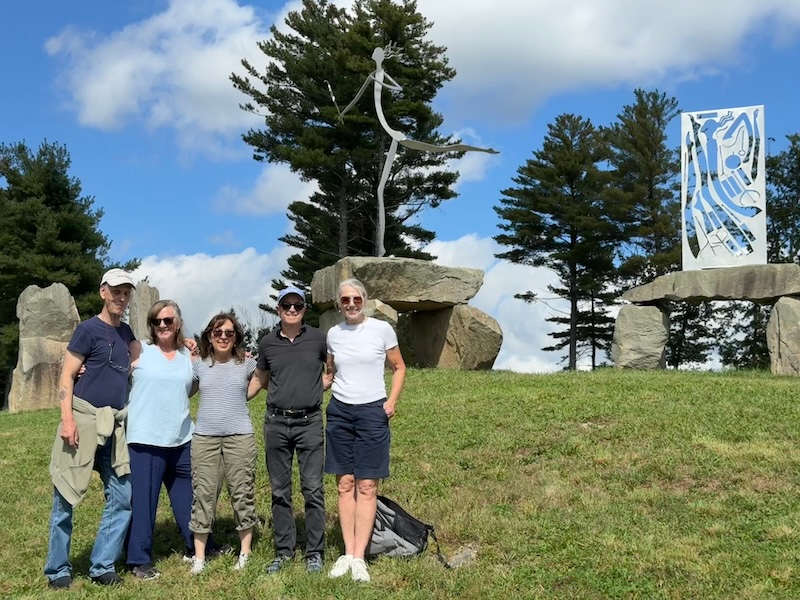

Yesterday, Sherry gathered some of our Connecticut neighbors for a visit to Hogpen Hill, which showcases the artwork of Edward Tufte. Our little group included Eileen, John, Cheryl, Sherry and myself.
Hogin Hill is a beautiful and sprawling 234 acres tree farm and sculpture park in Woodbury, CT with 100 sculptures and megaliths. Pulling up the long drive, we were treated to some clever and whimsical signage and a giant fish or two hanging overhead. Despite early forecasts calling for rain, we ended up with a sunny and warm day to explore the campus.

A surprise connection
Whenever I engage in one of these adventures, I am always surprised to find connections to my own life. Edward Tufte, or ET as he sometimes refers to himself is an expert on data analysis and visualization, with advanced degrees in statistics and political science from Stamford and Yale. He was co-inventor of the “blue-box” that was used in the 1960s-1970s to produce tones mimicking in-band signaling to make free long-distance phone calls, leveraging a vulnerability in AT&Ts systems. I learned about these systems when studying electronics in the 1970s. That alone makes him a personal hero of mine.
ET is a big thinker and has art pieces on visualizing quantum mechanics including “Feynman Diagrams” visualizing the statistical motion of the most tiny particles. His sculptures are creative, whimsical, sometimes out-of-this-world and frequently include the shadows created by the structure as part of the visual.
We caught up with him towards the end of a tour while he was explaining his exhibit “Escaping Flatland.” He described this large sculpture, made entirely of stainless steel slabs up to 12 feet high which reacts to changes in the position of the sun to create changing environments. He was particularly proud of this piece, which is both an engineering achievement and a personal statement on escape from the corporate world and academia.
In a similar vein his “Twigs” sculptures create improbable three dimensional patterns on the ground (almost like an Escher painting) using “light and air.” When he explained how difficult they were to build, I was taken that the welding taking place in the sky, the rotational positioning on the ground and the shadow of each element, however small, was important to the image he visualized.
When he spoke he explained that he “sees things” and then hires contractors to create his visions. It is clear that he does not want words to describe the art, he wants people to see for themselves. I got the impression that his artwork was almost an accidental extension of his thought processes.


A break and another surprise
After much walking our group took a break in a shelter made from half of an old Airstream trailer. As we were exiting, Eileen ran into Sarah, her yoga instructor from Evolve in New Milford. Small world.


Many favorites
I had two favorite pieces:
- The very unexpected “Sundial 2” which looks like a jet engine or hydraulic pump from the outside. When you walk to the opening and peer inside, it resembles an eye. After a moment or two you see the small ball of light on the “iris” identifying the time by its position.
- “Rocket Science 3: Airstream Interplanetary Explorer,” which uses a huge structure to put an airstream trailer into the sky, as if it is traveling into outer space. It is complete with a rotating television antenna, and flashing lights. Outside it has rocket engines, a folding beach chair, his Feynman sculptures and a plaque on the side pranking the one on the Voyager spacecraft.
Clearly, the aliens that discover this will know we are intelligent creatures, indeed.


A final surprise
We almost missed our last stop before departing. His “Bamboozerie” is an entirely natural, bigger than life sculpture made up of a grove of growing bamboo. We are meant to quietly explore the light and air in this cozy space, which gave me an idea for one last picture.
