
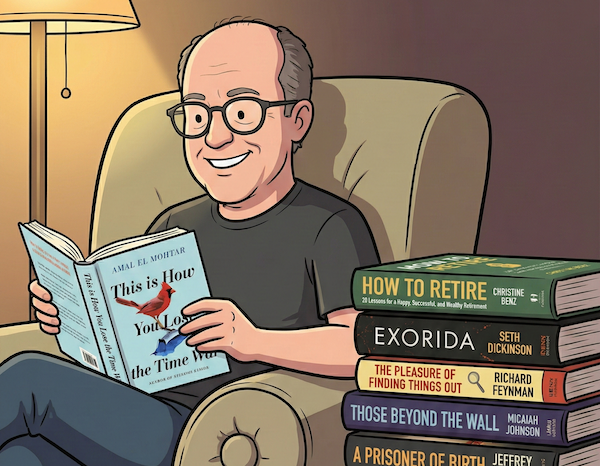

Reading a single good-quality book can be an adventure, taking a reader to a place they’ve never been.
Despite piling on sixty-four other adventures, I challenged myself to still find time to read this year. I upped the ante by setting a goal of reading at least one per month. This is significant, because I normally read only 4-6 books per year. Now that I am retired, this is a good new pace to maintain. The challenge for me is not the reading, but choosing books that I will like, so if you have suggestions, bring them on!
I can now report that I have beaten that goal, having completed a baker’s dozen books this year: three science fiction, three non-fiction/science, three about history, two with a historical fiction theme, one exploring relationships, and one on retirement.

As I write this, it’s the first time that I have looked at the entire list, and I realize that a few themes emerge: A) You’ll be able to tell that I love science, space and the future (this will not be a surprise to anyone). B) If you look closely, there seems to be a repeated theme of communication, communicating and relationships between people. Maybe this happened subconsciously because of my need to connect with people in retirement, taking the place of connecting at the office. C) Since my year of adventure is really a year of exploration for me, I seem to have been drawn to stories about discovery, perhaps projecting my own experience this year into the choices I made. I hope you enjoy:
- This is How You Lose the Time War by Amal El Mohtar (Sci Fi). I started my year off with this beautifully written book, consisting of letters between two opposing warriors written and hidden over the course of many millennia of fierce struggle. It exposes how even the most brutal competitors can have inner feelings, can respect their opponent and may question their own motivations. In its own way, it’s even a love story.
- How to Retire, 20 Lessons for a Happy, Successful, and Wealthy Retirement by Christine Benz (Non-fiction/Finance). Early this year, I read this book, by my favorite Morningstar columnist, with twenty lessons from experts on retirement. From groundwork to relationships, social security to spending plans, investments to estate planning, this is my new bible. A copy sits on my desk with dozens of sticky notes filled with action items and questions for myself. Totally worth reading twice (or three times)!
- Exorida by Seth Dickinson (Sci Fi). The book begins with an eight-headed alien creature in NY’s Central Park, in present day earth. It combines military strategy with moral dilemmas and complex concepts in math and physics as it charts the course of a woman who assists the alien as humanity’s last hope. It’s also a story about how far you would go for friendship, and that sometimes trust can be a dangerous choice. It’s a challenging non-linear read, but it is well visioned, has cool science and tough moral choices.
- The Pleasure of Finding Things Out by Richard Feynman (Non-fiction/science). This is a collection of Richard Feynman’s best short works, including interviews, speeches, and articles assembled by his estate. I read this book after hearing so many great things about this famous scientist and how funny he is, but found the book far too technical. In fact, he said it himself “when it comes to physics, if you don’t know the math, you don’t know the science.” I thought I was pretty good with math. Sorry not so much. Surely You’re Joking, Mister Feynman may have been a better choice.
- Those Beyond the Wall by Micaiah Johnson (Sci Fi). This book is a spin-off from Ms. Johnson’s Space Between the Worlds, a multi-universe thriller which I enjoyed last year. This story stays in just one universe but follows a dystopian society fully aware of the other universes, while delving into the divides between rich and poor. Nicely done!
- A Prisoner of Birth by Jeffrey Archer (Fiction). This book was recommended by Ali and has as its protagonist a man falsely accused of murder in England. It is full of interesting characters, a love interest and some unexpected plot twists. It was thoroughly enjoyable. Thanks Ali!
- Nexus: A Brief History of Information Networks from the Stone Age to AI by Yuval Noah Harari (Non-fiction/Science & History). This book by one of my favorite authors (Sapiens), takes us on a journey to explore how communications systems are the glue that lets a society grow. Communication systems can be used for good or evil, and I really appreciated the chapter where he describes bureaucracy as “a critical mechanism for imposing order on a complex world.” He also argues that communication systems often create order at the expense of truth. Heady stuff for today’s world considering social media and AI. There are lot of good thoughts here, but the book is repetitive and felt like a slog.
- The War Years, A Memoir by Martin Sylvester (Non-fiction, History). One of the most meaningful books I read this year was written by the father of one of my water skiing buddies. Now 100 years old, and still going strong, Martin describes his time in the trenches and behind enemy lines during World War II: June 1943-December 1945.
- The Ride, Paul Revere and the Night that Saved America by Kostya Kennedy (Non-fiction, History). When I heard that our friend Kostya had written this book, I ran out and bought it. He is a great writer and friend from the neighborhood. The subject of Paul Revere always fascinated me and was enhanced by our adventure in Concord with Winston (adventure #39) when we learned that this history of those early days were critical in the formation of our country.
This book takes us deep into Mr. Revere’s background and explores the details leading up to and through the night of his famous ride. Although we all know how it ends, Mr. Kennedy manages to keep much of it a mystery. - Supercommunicators: How to Unlock the Secret Language of Connection by Charles Duhigg (Non-Fiction/Sociology). I chose this book out of curiosity about people I know who manage to have a natural flair for connection with others. Mr. Duhigg describes techniques including matching tone, looping, asking deep questions and more as ways to gain trust and have people open up. The book provides examples of the tools in practice. One stood out: A jury with a clear cut case of gun possession by a disabled man and a harsh law. One juror, certain that justice was more important than the letter of the law, convinced the others one-by-one not to convict.
If you want to have some fun, you can type the book’s title into the google AI assistant and have a conversation using these techniques. They really work! - The Wager by David Grann (Historical fiction). This book, recommended by my friend Nicole, re-envisions a 1700s naval chase from England. The true story has been dramatized but is based upon real-life journals left by the crew members. The mission is doomed from the start, and results in mutiny, marooning and murder. It was a good read that expanded my view of life at sea, military structure and the international conflicts at the time.
- Israel, A Simple Guide to the Most Misunderstood Country on Earth by Noah Tishby (Non-fiction history). This book had been recommended to help to explain the underpinnings of the current situation in the middle east. It is written in a personal, entertaining style and juxtaposes history with Ms. Tishby’s childhood, telling the story from the perspective of an Israeli. If you think you know the entire background, there is plenty here that you may have been missing. Well worth reading.
- A Crack in Everything by Marcus Chowan (Non-fiction/science). I enjoyed this book which tells the personal stories of the mathematicians, astronomers, radio telescope operators and physicists who discovered that black holes not only exist, but make up a significant portion of our universe. Einstein had theorized that they existed nearly 100 years before we were able to see one, and the ingenuity of these scientists is worthy of respect. As the book explains, black holes, quasars and pulsars were thought to be rare, but we now know that they are commonly found in our universe.


“Twinkle, twinkle quasi-star
Biggest puzzle from afar
How unlike the other ones
Brighter than a billion suns
Twinkle, twinkle, quasi-star
How I wonder what you are.”
– George Garnow
